
Japan Digital Nomad Visa: How Long You Can Stay & Where
Japan’s digital nomad visa allows 6 months with no extension and needs ¥10M income. How to find housing that fits those dates.
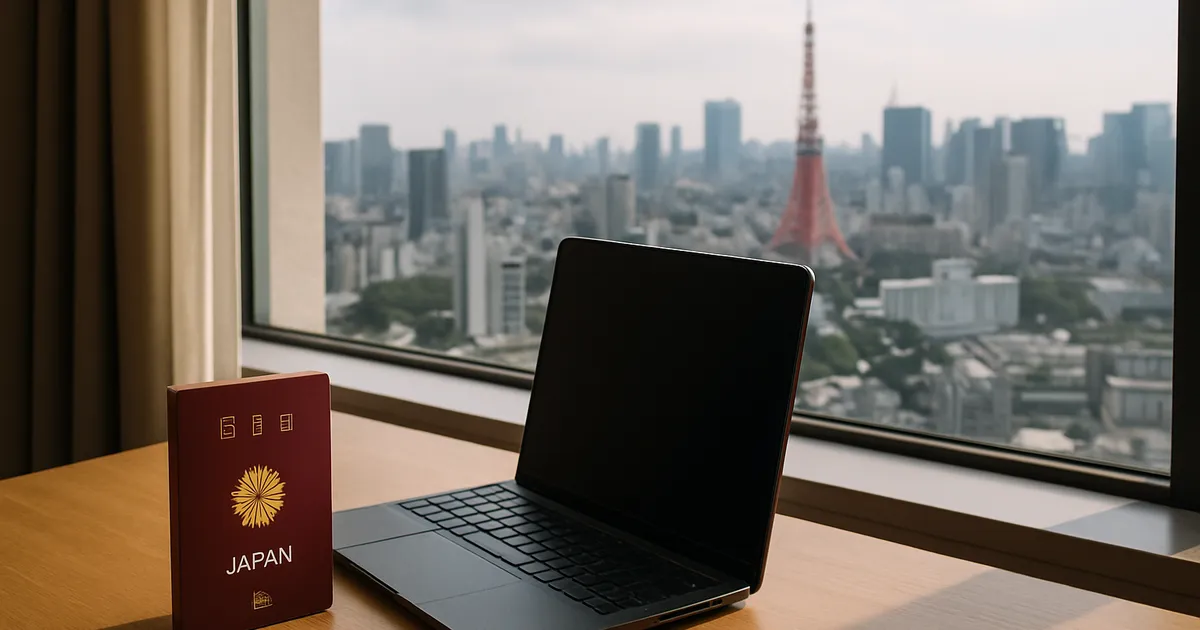
Japan's digital nomad visa lets you live in Japan for up to 6 months, with no extension, if you earn at least ¥10 million (about US$67,000) a year from employers or clients outside Japan. Because you get no residence card and cannot stay past 6 months, the practical housing choice is a furnished monthly rental booked for your exact visa dates, not a standard Japanese lease.
Below are the rules as the Immigration Services Agency of Japan publishes them, and what they mean for finding somewhere to live in Tokyo.
What are the Japan digital nomad visa rules?
The status is officially a type of Designated Activities visa, introduced in 2024. The Immigration Services Agency of Japan (moj.go.jp/isa) lists these conditions:
- Work: remote work using IT for an employer or clients outside Japan. Work for Japanese companies is not allowed.
- Income: at least ¥10 million a year at the time you apply.
- Nationality: you must hold a passport from a country or region that has both a visa-exemption arrangement with Japan and a tax treaty with Japan. That includes the US, the UK, Canada and Australia. The agency publishes the full list as a PDF; check it for other countries.
- Insurance: private medical insurance covering death, injury and illness during the stay, with at least ¥10 million (about US$67,000) of cover for medical treatment.
- Length: up to 6 months. No extension is granted. After it ends, you must wait 6 months before applying for the same status again.
- No residence card is issued.
- Family: a spouse and children can come with you on a matching status, for the same 6 months, each with their own qualifying insurance (a family policy can cover them).
You apply through the Japanese embassy or consulate that covers where you live, not from inside Japan. The Japan National Tourism Organization (japan.travel) summarizes the same 6-month limit and ¥10 million income rule. Visa fees and document lists are set by each embassy, so confirm them there before you apply. Rules can change; treat the agency's page as the final word.
How does the visa affect where you can live?
Three of the rules shape your housing options directly.
6 months, no extension
A standard Tokyo lease is usually two years, and leaving early can mean penalties. With a hard 6-month limit, a lease you know you will break makes little sense. Monthly rentals let you book the exact months you have.
No residence card
Many long-term landlords and guarantor companies expect a residence card and a Japanese phone number or bank account. Without a card, a regular lease is hard to get. Furnished monthly rentals that work with foreign guests often need only your passport and a simple contract; ours do not ask for a guarantor.
Upfront costs
A regular lease often starts with reikin (key money), a security deposit, an agent fee and a guarantor company fee, plus buying furniture and opening utility accounts. For 6 months, that money is mostly lost. Our guide on how to rent an apartment in Tokyo without a guarantor explains each fee.

What does 6 months of housing cost in Tokyo?
Using our own monthly homes near Ekoda and Tokiwadai as the example, rent includes electricity, gas, water and internet, and there is no key money, guarantor or agent fee:
| Home | Monthly | 6 months |
|---|---|---|
| Cozy Studio near Ekoda (1 guest) | ¥90,000 (about US$600) | ¥540,000 (about US$3,600) |
| Sengawa House 1LDK (1–2 guests) | ¥160,000 (about US$1,070) | ¥960,000 (about US$6,400), plus a ¥20,000 one-time cleaning fee |
| Tokiwadai House 2DK (1–2 guests) | ¥180,000 (about US$1,200) | ¥1,080,000 (about US$7,200) |
Because utilities and Wi-Fi are already in the rent, there are no bills to set up in Japanese. For a line-by-line breakdown, see monthly apartment Tokyo rent: utilities included and what else is covered.

How to plan housing around your visa dates
- Get the visa first, then lock the dates. Ask the host to hold dates while your application is processed, but do not pay for months you may not use.
- Book in whole months. If your stay is 5 months and 3 weeks, compare the last partial month against a few nights in a hotel.
- Pick for work, not just location. Look for unlimited Wi-Fi, a table or desk you can use for eight hours, and a quiet street. Our guide to a digital nomad apartment in Tokyo has a full checklist.
- Plan the exit. You cannot extend, so book your flight out when you book the apartment.
Many nomads spend the first month near the center and then move to a quieter neighborhood. Ekoda is about 7 minutes by local train from Ikebukuro, which is enough to keep the city close and the rent lower. For the wider market, see our complete monthly apartment Tokyo guide.
FAQ
Can I extend the Japan digital nomad visa?
No. The Immigration Services Agency says no extension is granted. You must leave and wait 6 months before applying for the same status again.
Can US citizens get the Japan digital nomad visa?
Yes, the US is on the eligible list, as are the UK, Canada and Australia. You still need ¥10 million in annual income, qualifying medical insurance and work for clients or employers outside Japan.
Can I rent a normal apartment on this visa?
It is difficult. No residence card is issued, and most long-term leases expect one. Furnished monthly rentals are the usual route.
Can my partner and children live with me?
Yes. A spouse and children can join you for the same 6 months, each with their own medical insurance or cover under a family policy. For a family, a larger home works better than a studio, so ask us about our whole-house options.
Book housing for your 6 months
Coming alone? Check 6-month dates for the Cozy Studio near Ekoda, ¥90,000 a month with Wi-Fi included. Coming as a couple? See the Tokiwadai 2DK, two rooms for two remote workers.
Dollar figures use ¥150 = US$1.
Monthly homes near Ekoda

Planning a trip?
Ask us anything about the area in English.